Reverse Kegels for Men: Relax to Last
5 min read · by Woody Wu, Coach
Published July 10, 2026 · Updated August 1, 2026
Medically reviewed by Steven Tijerina, Doctor of Physical Therapy (DPT), Cert. MDT
The pitch fits in one line: the muscle that stops your pee is the muscle that ends sex too soon, so build it like a bicep and it will hold. Forums have sold that line for years, and it keeps sending men into eight-week programs of a hundred squeezes a day. Plenty of them come out faster than they went in, timed on their own phones, because the line gets the muscle right and the training exactly backward.
The harder you squeeze, the sooner it is over.
The short answer. A reverse kegel is the opposite of a kegel. A kegel lifts and squeezes the pelvic floor up. A reverse kegel lets that same muscle lengthen and drop. For lasting longer, the release is the move that matters, because a relaxed pelvic floor calms the ejaculation reflex, while a hard clench tends to trip it. Most advice online has it backward. The skill worth learning is not a harder squeeze. It is letting go on demand.
That outcome is not rare. Most advice online tells men to squeeze, and for finishing fast that is the wrong pedal. If clenching has left you feeling tight or worse off, start with the signs you are overdoing kegels, then come back. And if you want the whole method this pillar sits inside, the complete guide to lasting longer lays it out end to end.
Why squeezing backfires
Ejaculation is a reflex, like a sneeze. You do not control the reflex itself. You control the excitement that leads up to it.
Picture your arousal as a car rolling toward a wall. Down near the base of you sit two pedals. One eases the car back. One lunges it forward. They are close together, they feel almost the same under pressure, and most men have spent years flooring the wrong one and calling it holding on.
If you relax the pelvic floor, you can hold the reflex back. If you squeeze it hard, you tend to trigger the reflex faster.
That is the whole reframe. Clenching to hang on is stamping the gas to try to slow down. The pelvic floor muscles are directly wired into the mechanics of ejaculation (Cohen et al., Sexual Medicine Reviews 2016), which is exactly why which pedal you press changes how fast you arrive.
What a reverse kegel actually is
Think of two directions in the same muscle. Up is the kegel: lift and grip, the gas. Down is the reverse kegel: soften, lengthen, let it sink, the brake. You already know the down direction. It is the quiet release at the very start of a pee, or the gentle widening at the base of the pelvis when you breathe out into your belly.
The goal is not to push down hard. Pushing and straining is just another kind of tension, another foot on the gas. You are looking for the feeling of the muscle letting go.
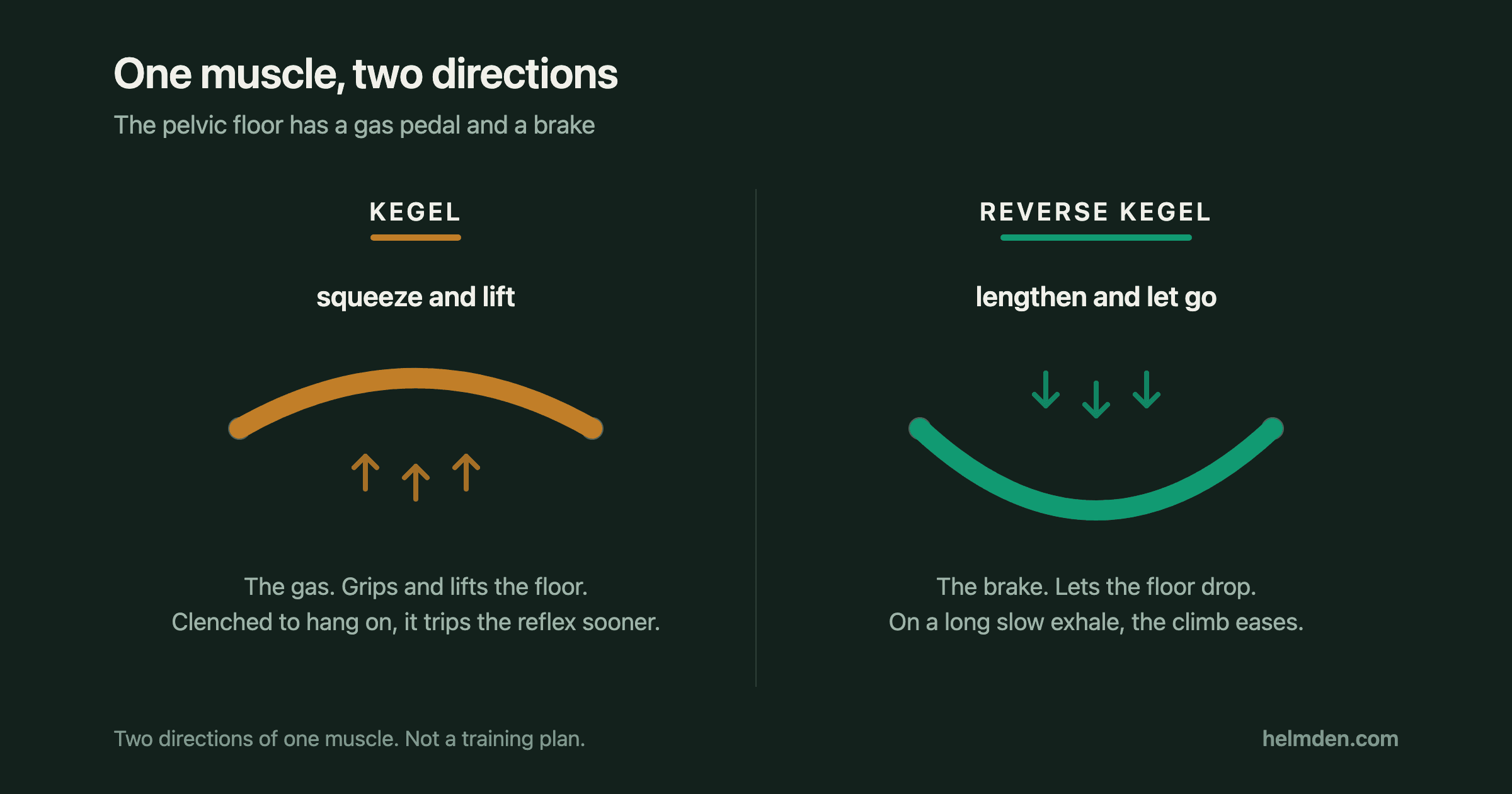
One muscle, two directions: the kegel grips and lifts, the reverse kegel lets the floor drop. The release is the brake.
How to do a reverse kegel
- Lie down or sit comfortably. Put a hand low on your belly.
- Breathe in slowly through your nose so the belly rises and the base of the pelvis feels like it widens a little.
- Breathe out long and slow. As you do, let the pelvic floor go soft and sink. Do not squeeze anywhere.
- Rest. Repeat for five or six slow breaths. That is one short set.
If nothing obvious happens the first few times, that is normal. Relaxing a muscle you have spent years clenching is a skill, and it comes with practice. The clinicians who teach this method start every man here, with the brake, before any strengthening.
How to use it when it counts
Once you can find the release lying down, bring it into real conditions. During solo practice or sex, keep breathing slowly through your nose. When you feel arousal climbing, do not grip. Let the pelvic floor go soft and stretch the exhale out. You will feel the intensity ease. That soft release is the brake. You are not pressing the gas harder. You have found the other pedal.
None of this is about trying harder at the last second. It is about noticing earlier and easing off sooner, a skill that builds fast once you know what to feel for. A tight, non-relaxing pelvic floor is a recognized and trainable pattern, and down-training it is a normal part of pelvic-health care, not a fringe idea (Faubion et al., Mayo Clinic Proceedings 2012). If that clench shows up mainly when the pressure is on, the tension is often anxiety in muscle form, and sexual performance anxiety covers the head side of the same problem.
The trade is simple to name and strange to make: stop stamping the gas and go looking for the brake, a hundred hard squeezes a day traded for a few slow releases. It feels like doing less, which is why most men take a while to trust it. Same muscle. The other pedal.
The two spokes of this method go deeper: what it looks like when kegels are being overdone, and what pelvic floor therapy for men actually involves if you want hands-on guidance.
Educational content, not medical advice. If finishing fast comes with pain, lost erections, or started suddenly, talk to a health professional.
FAQ
- What is a reverse kegel?
- It is the opposite move to a kegel. A kegel lifts and squeezes the pelvic floor up. A reverse kegel lets that same muscle lengthen and drop, like the soft release at the start of a pee or the gentle bulge when you breathe out into your belly. It is a letting-go, not a push.
- How do you do a reverse kegel?
- Breathe in slowly and low, so the belly and the base of the pelvis widen. As you breathe out long and slow, let the pelvic floor soften and sink rather than tighten. You are aiming to feel the muscle release, not to force anything down. A few slow breaths is plenty to start.
- Do reverse kegels help you last longer?
- For many men, yes, because a relaxed pelvic floor calms the arousal climb, while a hard clench tends to trip the reflex sooner. Reverse kegels are the skill of relaxing that muscle on demand. They work best paired with reading your arousal early, not as a last-second trick.
- Are reverse kegels safe?
- Relaxing and lengthening the pelvic floor is gentle and low-risk for most men. What is not helpful is doing hard clenches or straining. If you have pelvic pain, back pain with leg weakness, or urinary problems, see a pelvic-health clinician first. This is education, not medical advice.
- How long until reverse kegels work, and how often should I do them?
- The release itself usually gets easier to find within a couple of weeks of daily practice, and steadier control during sex tends to build over a month or two. There is no fixed timeline, since it is a skill, not a dose. For how often, a couple of short sets a day is plenty. This is not a reps game, so more is not better: a hundred hard clenches is what causes the trouble, not a few slow releases.